
Two enthusiastic thumbs up for “Mel Fell” by Corey R Tabor
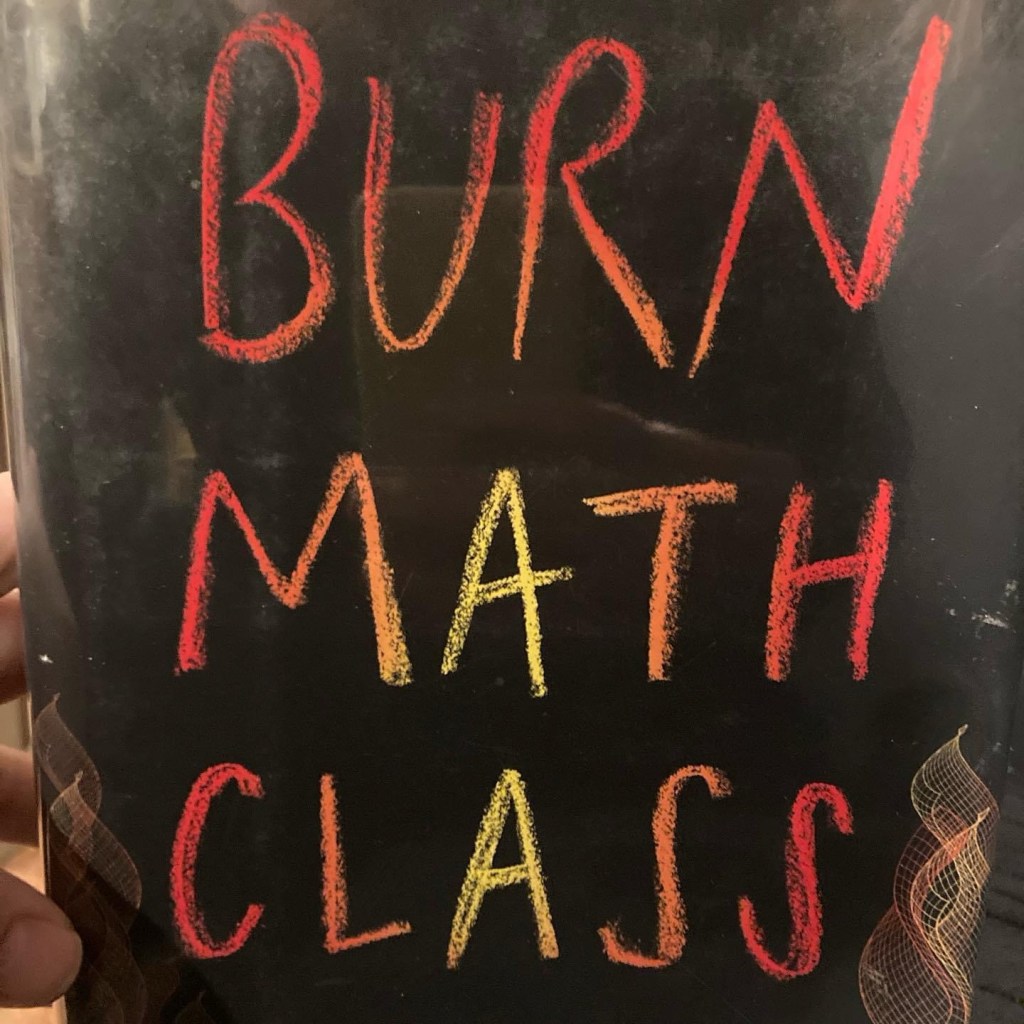
I did something that I haven’t done in awhile: I used the library card catalog to fine a book on a topic. Jason Wilkes’s book “Burn Math Class and Reinvent Math for Yourself” came up.
From the Prefacer: “Introducing a concept like this(i) leaves open infinitely many questions, (ii) makes any reflective student feel as if they are missing something, (iii) implicitly suggests that it is their own fault for not understanding it…..When I first heard the definition of slope in high school…I felt something like ‘I couldn’t invent any of these definitions on my own, from first principles, so there’s something I don’t understand about all of them.”
Oh I love when an author can put into words my exact experience. This is going to be good. #momslearningtoo #lovethelibrary #allforhomeschool

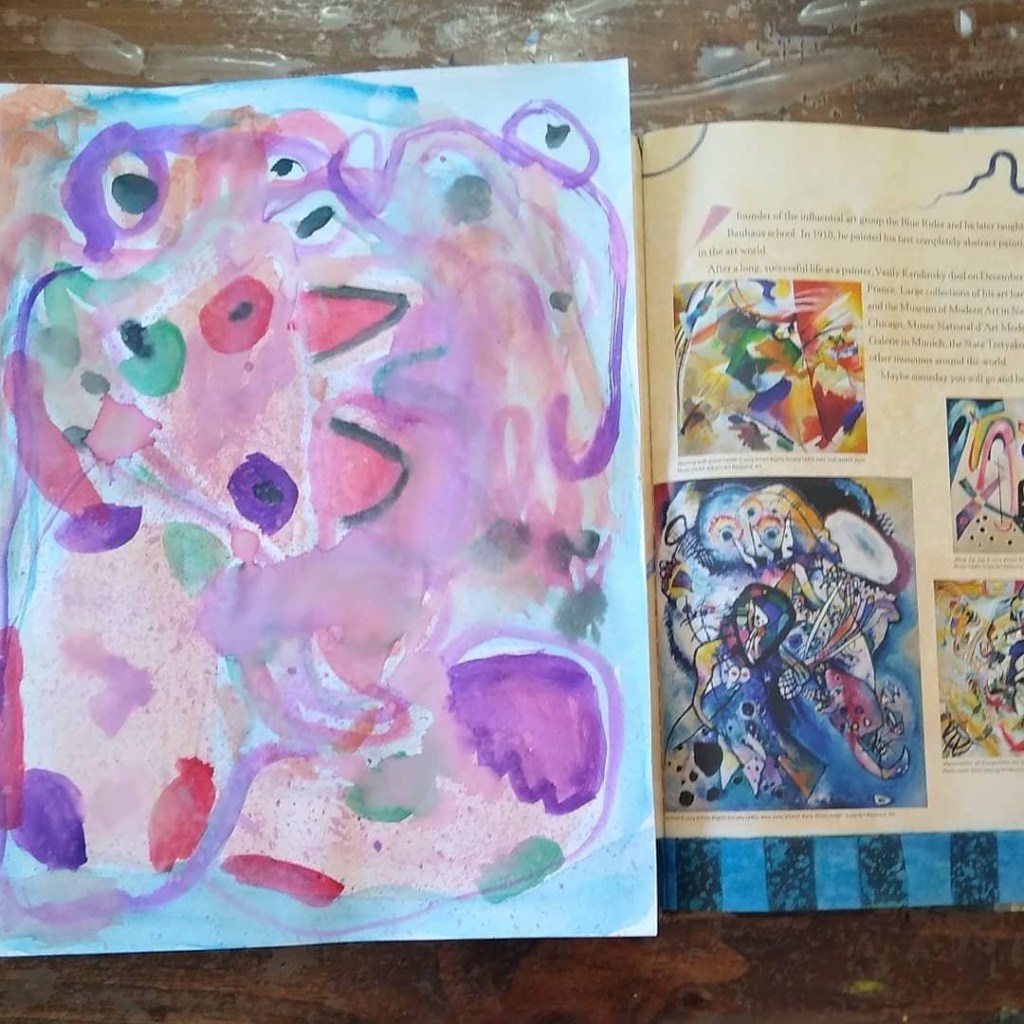
I continue to underestimate the inspiration factor of a good picture book. “The Noisy Paintbox” is about Kandinsky, his invention of abstract art, and probability that he had synesthesia (he heard sound when he saw color). Islarose and NinaBeana had to go paint immediately after I read it to them
@noisypaintbox

We LOVE this story we checked out from the library. It is based on the true story of the author’s grandmother who, when she was 6 years old, moved with her mother and 7 brothers and sisters into a little shack deep in the woods of Wisconsin. (It was 1932, they were evicted from their home and their father died of cancer before he finished moving them into the shack.). We loved reading about the treasures they found in the woods and the games they invented to make their hard work fun. Also the pictures are beautiful.

Playing a game they made up where they roll a dice and hop squares. Different colors mean different things- red is “penalty” blue is “challenge” yellow means they get to roll 2 dice on their next turn. #mychildrenaregeniuses #quarantineisclothingoptional


I’ve always thought it was funny that the girls in fairy tales could bribe fairies to do nearly impossible tasks by giving them bracelets or rings or necklaces. Those capricious little creatures will spin straw to gold and all kinds of other things for a sparkly trinket.
Today in church as I tried to bribe my own capricious, willful, little creatures to do the nearly impossible (sit still and quiet for an hour) by giving one my ring and one my necklace and one all the pennies from my purse, I realized my life is just like a fairy-tale 😂
Our physical bodies are truly an amazing gift. More summer book love:
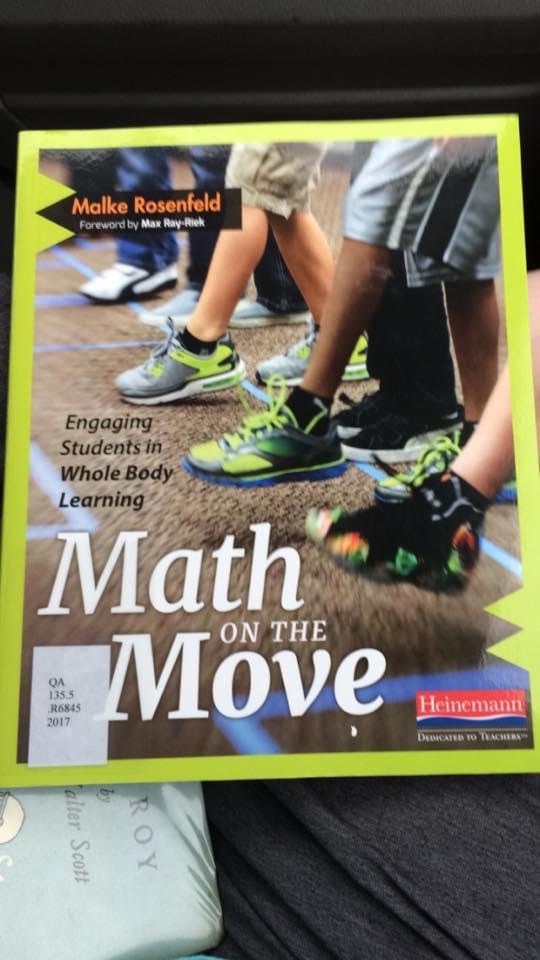
“The phrase ‘body knowledge’ is such a potent one. It is a challenge to our collective conception of what knowledge is and where it resides; it also places the student in the very center of the learning process. Body knowledge, also referred to as embodied cognition, helps us understand the processes of thinking and learning with our bodies. ..Developmental psychologists have shown that in babies, ‘cognition is literally acquired from the outside in.’ This means that the way babies physically interact with their surroundings ‘enables the developing baby to educate herself…just by perceiving and acting in the world.’ …some researchers are focused more specifically on the variety of ways the body is involved in learning and expressing mathematical ideas…focusing on the whole body as the primary actor ….quite literally the ‘object to think with’ within a mathematical investigation…in general, the research over the past few decades has resulted in general acceptance that it is impossible to ignore the body’s role in the creation of mind and thought, going so far as to agree that there would likely be no mind or thinking or memory without the reality of our human form living in and interacting with the world around us.”
-Malke Rosenfeld, Math on the Move: Engaging students in Whole Body Learning.
Such a great book. This author uses percussive dance to teach mathematical concepts in classrooms. Finally! Examples of true kinesthetic learning. Additionally, I am understanding now why learning piano increases mathematical and spacial reasoning for children and why playing outdoors in the mud, climbing, running, and jumping, is so important for early childhood development.
❤️❤️❤️
I am 😍😍 this book
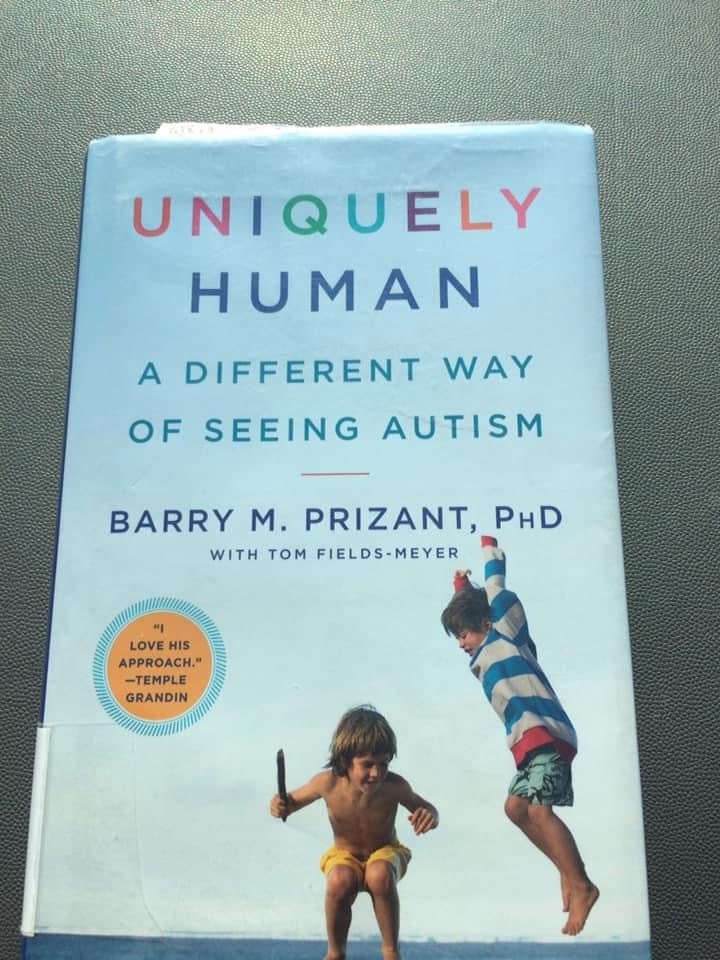
“Still, some parents and professionals view [the unusual interests of autistic children] as yet another undesirable symptom of autism…often their instinct is to discourage the child…[this teacher] saw enthusiasm as a source of potential rather than an impediment or a problem.”
Uniquely Human: A Different Way of Seeing Autism by Barry M. Prizant, PHD

I had heard about Herve Tullet and was super excited to find his books at our library. These delighted my children ages 3-10 (and I enjoyed reading them as well.)
It was my goal to read 60 books for 2018, and I only managed to finish 53. It was also my goal to only read books I enjoyed, and I dropped several without finishing, including Farewell to Arms by Earnest Hemingway and Origin by Dan Brown.
My favorite fun reads: My Lady Jane by Cynthia Hand (Thanks Katie)
The Night Circus by Erin Morgenstern, narrated by Jim Dale (this one is the first book I’ve listened to that I believe is a better experience listening than it would have been to just read myself)
Classic that I hadn’t read before that I still can’t talk about:
Random Harvest by James Hilton
All I can say for now is that it is what Brideshead Revisited could have been if Evelyn Waugh had written characters worth reading about.
The one book I read that I didn’t enjoy, but I finished because it was good for me:
The Inconvenient Indian by Thomas King
Books that I couldn’t stop talking about:
At Home by Bill Bryson (thanks, Ruth)
The War to End All Wars by Russell Freedman
Play: How it Shapes the Brain, Opens the Imagination, and Invigorates the Soul by Stuart Brown
The Talent Code by Daniel Coyle
Best Family Read-alouds:
Dead End in Norvelt by Jack Gantos
Little Britches by Ralph Moody
Top 3:
No Greater Love by Mother Teresa
Man’s Search for Meaning by Victor E Frankl
Essentialism: The Disciplined Pursuit of Less by Greg Mckeown


 Marvelous Pigs in Satin