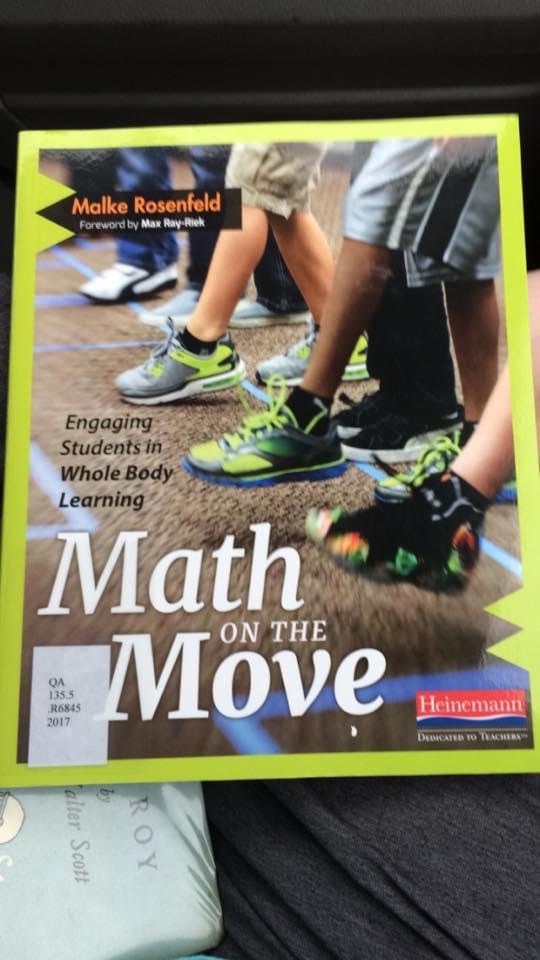
Our physical bodies are truly an amazing gift. More summer book love:
“The phrase ‘body knowledge’ is such a potent one. It is a challenge to our collective conception of what knowledge is and where it resides; it also places the student in the very center of the learning process. Body knowledge, also referred to as embodied cognition, helps us understand the processes of thinking and learning with our bodies. ..Developmental psychologists have shown that in babies, ‘cognition is literally acquired from the outside in.’ This means that the way babies physically interact with their surroundings ‘enables the developing baby to educate herself…just by perceiving and acting in the world.’ …some researchers are focused more specifically on the variety of ways the body is involved in learning and expressing mathematical ideas…focusing on the whole body as the primary actor ….quite literally the ‘object to think with’ within a mathematical investigation…in general, the research over the past few decades has resulted in general acceptance that it is impossible to ignore the body’s role in the creation of mind and thought, going so far as to agree that there would likely be no mind or thinking or memory without the reality of our human form living in and interacting with the world around us.”
-Malke Rosenfeld, Math on the Move: Engaging students in Whole Body Learning.
Such a great book. This author uses percussive dance to teach mathematical concepts in classrooms. Finally! Examples of true kinesthetic learning. Additionally, I am understanding now why learning piano increases mathematical and spacial reasoning for children and why playing outdoors in the mud, climbing, running, and jumping, is so important for early childhood development.
❤️❤️❤️


 Marvelous Pigs in Satin
Leave a comment